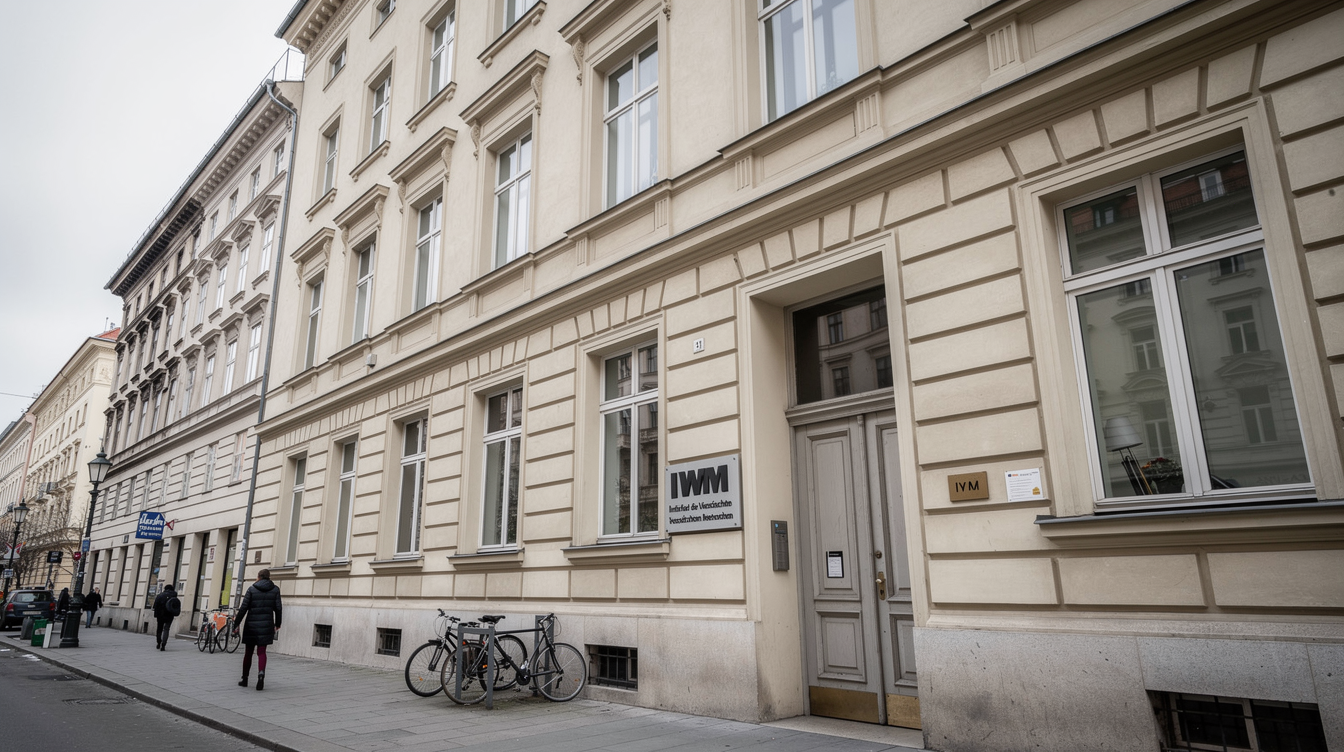
About the IWM
The Institut für die Wissenschaften vom Menschen (Institute for Human Sciences) is a private research institute in Vienna, Austria. It was founded in 1982 and has an international scholarly community of fellows, visiting researchers, and affiliated scholars working across the humanities and social sciences. Its work sits at the intersection of intellectual debate and European public life.
The IWM's podcast series was a regular publication, with episodes covering the institute's core areas of interest: European politics, democratic theory, sociology, the philosophy of the social sciences, and international relations. Guests included researchers, journalists, policymakers, and public intellectuals. Conversations were typically long-form — 30 to 75 minutes — and conducted with scholars and practitioners who expected to be engaged with at the level of their expertise.
The production work
The engagement covered the full production pipeline for each episode:
- Sound editing — removal of room noise, echo, and the technical artefacts common to remote recordings; tightening of pacing and argument flow
- Mixing — level matching between speakers, EQ to correct for microphone and room characteristics, balancing of multi-participant episodes
- Mastering — loudness normalisation to broadcast standard and platform delivery specifications
- Episode notes — written from the finished edit, accurate to the content, formatted for the major publishing platforms and optimised for search
- Publishing metadata — title, description, tags, and other platform metadata delivered ready for upload
- Editorial input — where relevant, suggestions on pacing, structure, or content — offered as options rather than prescriptions, and always subject to the client's approval
Subject matter and editorial engagement
The breadth of topics the IWM podcast covered — European democratic backsliding, theories of sovereignty, post-communist social transformation, the philosophy of the social sciences, Central European history, international relations theory — is not material that any producer can engage with competently on first encounter. The value of a sustained working relationship is that the producer develops a working knowledge of the institute's intellectual concerns, its recurring guests, and the specific vocabulary and references that recur across episodes.
My background in humanities scholarship (MA Renaissance Studies, University of Sussex) and my familiarity with political philosophy, sociology, and historical method made it possible to engage with the content rather than simply processing it. The practical effect of that engagement shows up in editorial decisions: knowing which digressions are intellectually productive and which should be cut; knowing whether a speaker's hesitation reflects genuine uncertainty or is simply a verbal habit; knowing how to write episode notes that accurately situate the argument rather than summarising it at the level of topic headings.
The working relationship
The IWM engagement ran for approximately five years. Over that period, the working relationship was consistent: agreed timelines were kept, communication was responsive, and the volume of revision requests was low because the work was delivered to the expected standard.
Dino Pašalić, who managed the podcast series at IWM, described the collaboration in the following terms:
I worked with Simon Clayton for nearly five years across 50 episodes of our podcast. The partnership has been consistently fruitful and productive.
Simon provided the complete production package: sound editing and mixing, mastering, and well-written episode notes optimised for the major publishing platforms. Particularly valuable was his reliability — agreed timelines were respected, and he was always responsive.
Beyond the technical work, his strong grounding in politics, sociology and international relations — the array of topics the podcast series covered — allowed him to offer relevant conceptual suggestions or constructive critique of the content.
Above all, Simon was a pleasure to work with: calm, good-humoured and thoroughly decent.
Dino Pašalić
Institut für die Wissenschaften vom Menschen (IWM), Vienna
What this demonstrates
This case study shows how academic podcast production works when an institution needs consistent quality over multiple years: dependable turnaround, subject-sensitive editing, and publication-ready delivery.
If you are commissioning a podcast series for a university, research institute, or think tank, this is the context in which to evaluate the service.
← Back to academic podcast production